
ITA’s BRIDGES Collective brings together Creative Arts Therapy programs, research, and community partnerships that unite with a shared belief in the power of integrating arts, culture, health, and human connection. Developed through ITA, The Collective supports individuals living with dementia and other neurological conditions, along with their caregivers and loved ones, by advancing collaborative approaches that enhance quality of life, strengthen relationships, and create opportunities for meaningful connection.
The Collective features three initiatives: Musical Bridges to Memory™ (MBM), Music-Based Empathy training for Frontotemporal Dementia (MET-FTD), and Rush Art BRIDGES (Building Resilience, Identity, and Dialogue through Guided Expression). Together, these initiatives explore how creative arts interventions can support communication, emotional well-being, social engagement, and relationships.
Our Programs & Research Initiatives
Musical Bridges to Memory™ (MBM)
Developed by ITA in partnership with Northwestern University Feinberg School of Medicine’s Music and Medicine Program, Musical Bridges to Memory™ (MBM) is a one-of-a-kind, evidence-based, set of programs designed to support individuals living with memory loss and dementia, and their care partners, by restoring connection through the power of music.
MBM combines caregiver education, live musical experiences, and facilitated small-group activities to support communication, engagement, and meaningful relationships. The program introduces caregivers to 24 research-informed, music-based techniques that can be incorporated into everyday interactions. Participants and caregivers practice these techniques during interactive concerts with professional musicians, followed by facilitated opportunities for reflection and support.
By engaging participants and their caregivers together, MBM emphasizes not only the individual benefits of music, but also its potential to strengthen relationships and improve quality of life beyond the program.
Music-Based Empathy Training for Frontotemporal Dementia (MET-FTD)
Music-Based Empathy Training for Frontotemporal Dementia is a research initiative developed through collaboration among ITA, Cleveland Clinic, and Northwestern University.
The intervention investigates whether music-based experiences can support empathy and social cognition among individuals living with behavioral variant frontotemporal dementia (bvFTD), a condition that can affect behavior, emotional responsiveness, and interpersonal relationships.
The project received a $50,000 pilot grant from the Music & Dementia Research Network, funded through a National Institutes of Health/National Institute on Aging cooperative agreement. During fiscal year 2026, researchers conducted a 12-week feasibility study using an at-home, empathy-focused music intervention.
Five participant-caregiver pairs enrolled, and four completed the intervention. Preliminary findings demonstrated that the intervention was feasible and suggested potential improvements in empathy, supporting further investigation.
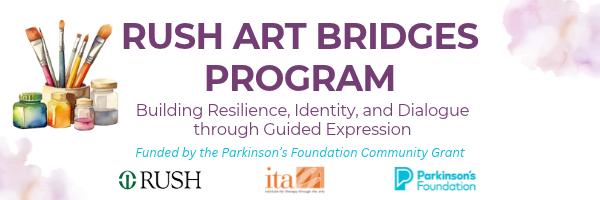
Rush Art BRIDGES
Developed in partnership with Rush Medical Center, Rush Art BRIDGES (Building Resilience, Identity, and Dialogue through Guided Expression) provides creative arts experiences for people living with Parkinson’s disease and their loved ones.
Support by a Parkinson’s Foundation Community grant, the program was developed to encourage connection, emotional expression, meaning, and resilience through guided artistic experiences. Workshops scheduled for Fall 2026 and Spring 2027 include playful painting, flower arranging, music and mood, storytelling, and comedy and laughter.
In addition to providing opportunities for creative engagement, the program is designed to evaluate participants’ experiences and potential outcomes related to anxiety, loneliness, sense of purpose, and caregiver burden.
A culminating gallery event is planned for late spring/early summer 2027.
Research & Measured Outcomes
Research and evaluation are essential to ITA’s approach. Our programs incorporate assessment tools, caregiver feedback, and observational measures to better understand the effects of creative arts experiences on participants and their caregivers.
Musical Bridges to Memory™ (MBM)
Research from MBM’s 10-week cohorts demonstrated encouraging outcomes among individuals living with dementia and their care partners
Social Engagement
Participants demonstrated increases in positive social behaviors, including smiling and attending to conversation.
Relationship Quality
Caregivers reported improvements in the quality of their relationships with loved ones over the course of the program.
Emotional & Behavioral Symptoms
Participants experienced reductions in reported symptoms such as anxiety, agitation, and irritability.
Caregiver Distress
Caregivers reported reduced distress related to their loved ones’ behavioral and emotional symptoms.
These findings were informed by qualitative and quantitative assessments, including measures of participant behavior, caregiver experiences, and neuropsychiatric symptoms. The results support continued investigation into how community-based music interventions can strengthen relationships and improve quality of life for individuals living with dementia and their caregivers.
MET-FTD; Preliminary Research Findings
The MET-FTD feasibility study used the Interpersonal Reactivity Index (IRI) to measure aspects of empathy before and after the intervention. Among the four participant-caregiver pairs who completed the 12-week protocol, researchers observed a mean improvement of six points on the IRI.
These preliminary findings suggest that the intervention is feasible and may support improvements in empathy. Additional research with larger participant groups will be needed to evaluate its effectiveness.
Rush Art BRIDGES: Planned Evaluation
Rush Art BRIDGES will evaluate program feasibility, participant experiences, and potential quality-of-life outcomes using completion data, feedback, field notes, and assessment measures. Areas of interest include emotional well-being, anxiety, loneliness, sense of purpose, and caregiver burden. Findings will help inform future programming and research.
Collaborating Through Research & Community Partnerships
ITA’s BRIDGES Collective reflects collaborations with healthcare institutions, researchers, community organizations, music therapists, and professional musicians.
Program and research collaborators include Northwestern University Feinberg School of Medicine, Cleveland Clinic, Rush Medical Center, Chicago Methodist Senior Services, Silverado St. Charles, Presbyterian Homes Westminster Place, Sukkat Shalom, and CJE.
These partnerships support the development, delivery, and evaluation of creative arts interventions across clinical and community settings.
Continuing Our Work
Through the BRIDGES Collective, ITA continues to explore how creative arts interventions can support quality of life, strengthen relationships, and provide meaningful opportunities for connection. Our ongoing work focuses on expanding community-based programming, building research partnerships, and evaluating the benefits of Creative Arts Therapy for individuals living with neurological conditions and their caregivers.